IT service sector Q3’26 summary: Profitability improved, but a turnaround in revenue is still a ways off


Summary
- Finnish IT services revenue continued to decline in Q3, with median organic growth of -2.5%. Profitability improved, as the median adjusted EBIT margin rose to 4.9% from 3.0% a year earlier.
- The sector’s Rule of 20 improved to 9 but remained weak. Public-sector savings, intense price competition and AI-driven change continue to challenge providers, while private-sector demand showed some signs of recovery.
- Inderes expects 2026 to remain a transition year, forecasting median organic revenue growth of -1% and profitability of 5.1%. It identifies Digia, Digital Workforce, Gofore, Reaktor and Witted as preliminary winners, and Siili, Solteq and Vincit as losers.
This content is generated by AI. You can give feedback on it in the Inderes forum.
Translation: Original published in Finnish on 11/19/2026 at 8:20 am EET.
At the end of last year, we saw positive signs in the IT services sector for the first time in a long while, as organic revenue temporarily returned to growth at the sector level. However, in the early part of the year, this turnaround did not carry over to the entire sector, and company-specific differences increased. In Q3’26, sector-level revenue continued to decline, but profitability improved significantly due to efficiency measures and exceeded our expectations at several companies. The divide between the sector's winners and losers remains clear.
Key findings
- Profitability improved, but revenue did not yet: Efficiency measures took effect, and profitability exceeded our expectations at several companies, but organic revenue continued to decline at the sector level.
- Revenue: Median organic development -2.5% (Q2’26: -3.3%, Q3’25: -1.8%). Digital Workforce (+10%), Reaktor (+3%), and Gofore performed best (+2%). Siili (-8%), Netum (-12%), and Vincit (-12%) saw clear declines. Compared to our estimates, 2 were above, 6 in line with and 1 below.
- Profitability: The average adjusted EBIT margin was 5.9% (Q3’25: 4.8%), and the median was 4.9% (Q3'25: 3.0%). Solteq (11%) and Digia (11%) were at the top, while Vincit (-2%) was the only one in negative territory. In terms of our estimates, 4 exceeded them, 2 were in line with them, and 4 fell below them.
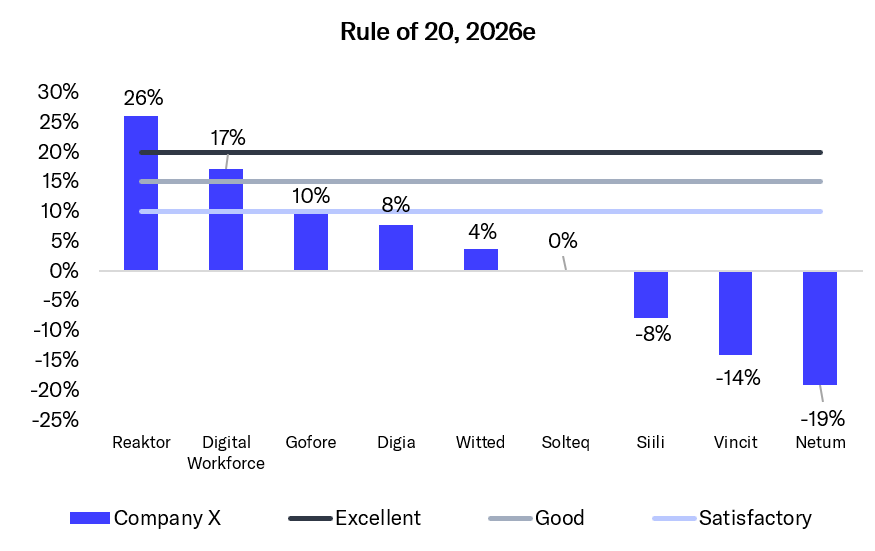
- Rule of 20: The sector median was 9 (Q2'26: 3), i.e., a clear improvement but still below a satisfactory level (limit 10). Digital Workforce (15) reached the threshold for a good level (limit at 15), while Reaktor (12), Gofore (10), and Digia (10) achieved a satisfactory level. The weakest were Siili (-3), Netum (-11), and Vincit (-14).
- Drivers: Savings in the public sector and intense price competition persist, and cautious recovery was seen in the private sector. During the earnings season, guidance was lowered by Digia (earnings), Netum, Siili, and Solteq (revenue), whereas Digital Workforce raised its guidance. Acquisitions support reported growth. Artificial intelligence is both an opportunity and a threat.
- Outlook for 2026: Another transition year in the context of the sector. We forecast a 1% decline in median organic revenue (3% excluding Reaktor) and a rise in median profitability to 5.1% (2025: 3.5%).
- Preliminary division into winners and losers stays the same: Digia, Digital Workforce, Gofore, Reaktor, and Witted are the winners, while Siili, Solteq, and Vincit are the losers. Netum remains a question mark. While Witted's growth outlook has also weakened in the short term, its profitability has improved beyond our expectations.
| Q3'26 | Growth, % | Organic growth, % | EBIT-% adj. | Rule of 20 |
| Q3'26 | Q3'26 | Q3'26 | Q3'26 | |
| Digia | -1% | -1% | 11% | 10% |
| Digital Workforce | 44% | 10% | 5% | 15% |
| Gofore | 20% | 2% | 9% | 10% |
| Netum | -11% | -12% | 2% | -11% |
| Reaktor | 3% | 3% | 9% | 12% |
| Siili | -8% | -8% | 5% | -3% |
| Solteq | -3% | -3% | 11% | 9% |
| Vincit | -12% | -12% | -2% | -14% |
| Witted | 4% | -3% | 4% | 2% |
| Finnish average | 4% | -2.60% | 5.90% | 3% |
| Finnish median | -1% | -2.50% | 4.90% | 2% |
Source: Companies and Inderes
| Q3'26 | Revenue vs. expectations | EBITA % (adj.) vs. expectations | EBITA % vs. expectations |
| Digia | Above | In line | 0.7 pp |
| Digital Workforce | Above | Below | -1.7 pp |
| Gofore | In line | In line | 0.4 pp |
| Netum | In line | Below | -6.6 pp |
| Reaktor | Below | Above | +2.1 pp |
| Siili | In line | Above | +1.5 pp |
| Solteq | In line | Above | +6.1 pp |
| Vincit | In line | Below | -3.1 pp |
| Witted | In line | Above | 1.4 pp |
Source: Inderes
The Rule of 20 shows improved progress in Q3, but sector remains weak
A couple of years ago, we launched our own Rule of 20 for the IT service sector, which we believe to be a good, if not the best, single indicator of the sector's and especially companies' operational performance, especially when viewed over the cycle. The current market situation over the last three years is more challenging than in the previous 10 years, and achieving an excellent level in the Rule of 20 is more difficult, whereas in the past, more companies achieved excellent performance.
The IT service market remained challenging in Q3, but the sector’s median “Rule of 20” figure improved to 9 (Q2’26: 3), though this is still a weak level. The improvement was driven by profitability, as organic growth remained negative. Among the listed IT service companies, Digital Workforce reached the good level threshold (15), while Reaktor (12), Gofore (10), and Digia (10) achieved a satisfactory level (threshold 10). Solteq (9) and Witted (2) fell below the satisfactory threshold but remained in positive territory. The remaining companies were at a very weak level, ranging from -3% to -14% (Siili, Netum, and Vincit).
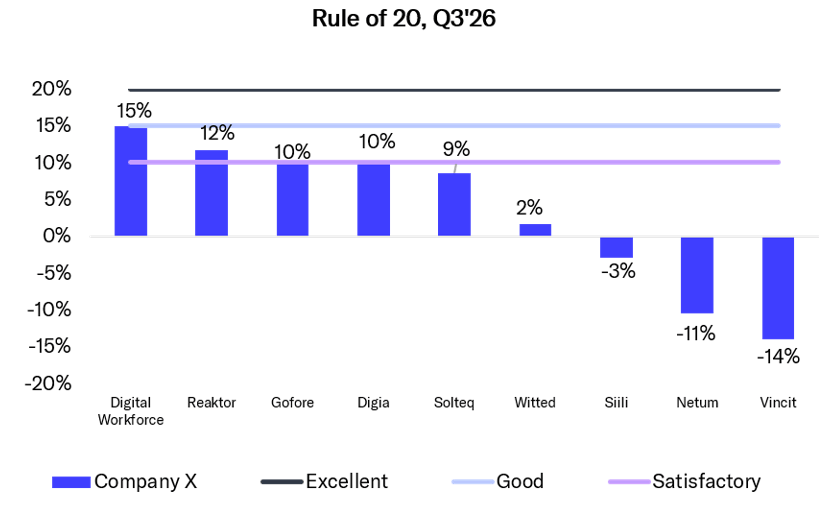
Source: Inderes, Rule of 20 = Organic growth-% + adj. EBITA-%
Revenue continued to decline at the sector level, but expectations were largely met
Revenues in the Finnish IT service sector developed largely in line with our expectations (2 companies above, 6 in line, and 1 below our forecast), and the median organic decline was -2.5% (Q2’26: -3.3%, Q3’25: -1.8%). Reported growth continued to be supported by acquisitions, as the average growth rate was 4%, while the median was -1%. Digital Workforce achieved the sector's best organic growth (+10%), driven by healthcare customers in the UK and the United States, as well as agentic AI products, according to the company. Reaktor's growth slowed to 3% (Q2’26: 11%), excluding licensing-related spikes, and revenue fell slightly short of our expectations. Gofore's organic growth came in at 2%, which is slightly below our expectation of 3%, as the turnaround in the DACH region has yet to materialize. Digia's organic revenue was close to that of the comparison period and exceeded our expectations as international business grew by 12%.
Revenue continued to decline organically at Solteq (3%), Witted (3%), Siili (8%), Netum (12%), and Vincit (12%). However, the pace of decline slowed from Q2’26 for Netum, Siili, Solteq, and Vincit, partly due to easier comparison figures. For these companies, the strategic transformation is still clearly ongoing as well. In turn, Witted's organic growth turned into a slight decline (Q2'26: +2%), as the company lost subcontracting contracts, particularly in Norway. The company has secured more profitable business to replace this loss, which was clearly reflected in improved profitability despite the decline in revenue.
In our view, the challenging market conditions seen in recent years and the market disruption created by AI will more clearly separate the winners from the losers in the sector. This is also reflected in the polarization seen in the sector during the whole year thus far. In our view, this allows companies to be preliminarily started to be categorized as winners or losers.
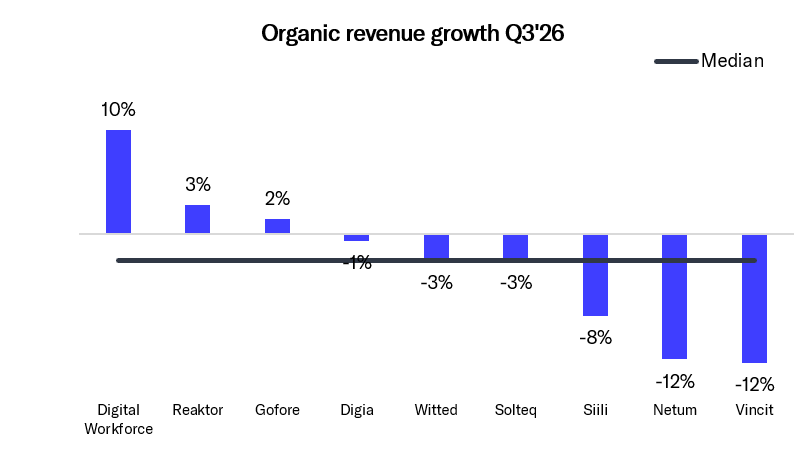
Source: Inderes
Market commentary in Q3 remained cautious overall, though a few companies expressed more optimism than before. Siili reported signs of market recovery and increased demand for AI modernization, while Gofore stated that the private sector's caution has mostly subsided. Conversely, Netum, Solteq, and Vincit reported that decision-making remains slow, projects are starting slowly, or order intake fell short of expectations. During earnings season, guidance was lowered by Digia (EBITA), Netum, Siili, and Solteq (the cuts by Digia and Solteq were already included in our Q2 report estimates), whereas Digital Workforce raised its revenue guidance in July. This reflects the fragile market situation and the fact that the upturn remains narrow. Among major Nordic players, Tieto’s organic revenue declined by 11% in Q3, but profitability remained strong (adj. EBITA 18.0%).
The market's continued weakness is reflected by the fact that 6/9 of the companies we monitor have restructured their operations this year to adjust their workforce.
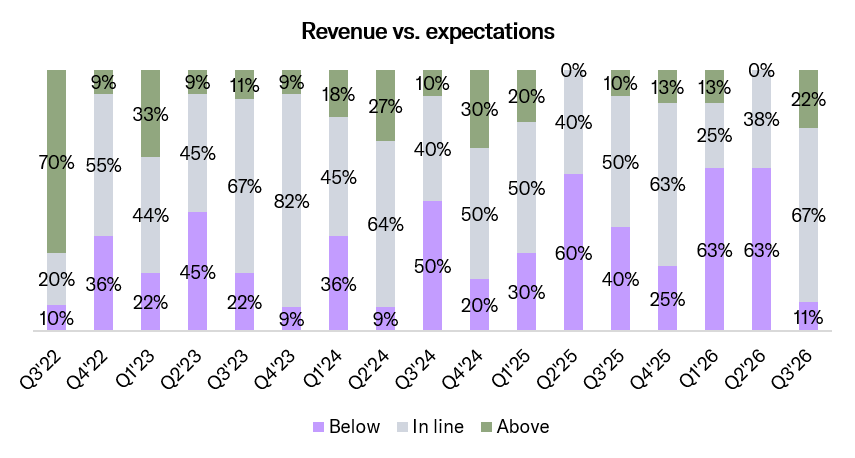
Source: Inderes
| 2026 | Public change negotiations | Revenue guidance cut | Guidance cut |
| Digia | Yes | No | Yes (9/2026) |
| Digital Workforce | No | No (raised 7/2026) | No |
| Gofore | No, but restructured | No guidance | No guidance |
| Netum | Yes | Yes (6/2026) | Yes (6/2026 and 9/2026) |
| Siili | Yes | Yes (8/2026) | Yes (8/2026) |
| Solteq | Yes | Yes (10/2026) | Close |
| Vincit | Yes | No guidance | Close |
| Witted | No, efficiency measures | No | No |
Source: Inderes and the companies
Growth has once again been more strongly supported by acquisitions last year and this year. Over half of the companies we follow have made one or more acquisitions, which supports this year's growth.
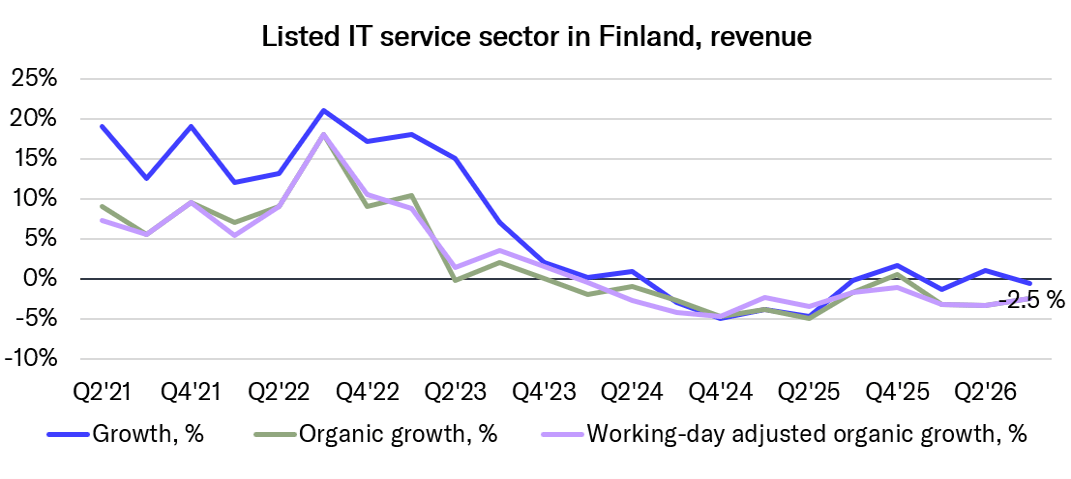
Source: Inderes
Market drivers: AI accelerates transformation and price competition remains fierce
Demand: Public sector still struggling, private sector showing some signs of life
The public sector market situation remains difficult due to the need for savings, but good operators are able to operate even there. The private sector appears to have partially recovered, which depends on the demand situation within each customer vertical. We would like to point out, however, that geopolitical risks and a potential rise in interest rates could further dampen customers’ willingness to invest, which we believe would be detrimental to the Finnish economy during the current period of economic improvement.
In general, we expect companies with clear competitive advantages and/or extensive service offerings to stand out more prominently in the future. The losers will be companies that lack critical (e.g., data, AI) or differentiating capabilities, deep customer relationships (management consulting, integration and continuity services contribute), or a deep understanding of the customer's business through industry focus.
Artificial intelligence is both an opportunity and a threat
AI has been a hot topic for quite some time now. It is an opportunity, but the disruptive threat it brings is also a significant risk, especially in software development. Progress has also clearly accelerated over the past six months. Nowadays, it no longer makes financial sense for developers to write code by hand but rather for AI agents to take on that task. In our view, the AI transformation will further separate the winners from the losers, and AI expertise will be a mandatory area of expertise in the future.
Companies with strong customer relationships will continue to succeed in the market in the future as well, even if they are not at the forefront of AI expertise. These companies know their customers well and understand better how to utilize AI in those particular customer relationships. We estimate that new sales and thus "infiltrating" customer relationships will continue to be challenging in the future, unless you have a broad service offering or cutting-edge AI expertise. Once again, we emphasize that adaptability is a key competitive advantage for companies and is particularly important in the age of artificial intelligence when customer needs are likely to change significantly in the coming years.
At the beginning of the year especially, the threat of AI disruption weighed heavily on several sectors of the stock market, including the IT service sector. However, in the IT service sector, this threat has been operationally known for a couple of years already. Technological development is now faster than before, which requires continuous adaptability from companies and keeps uncertainty elevated. The share price decline has stabilized, but no significant recovery has yet been seen in the companies we monitor. Meanwhile, there have been some sharp rallies elsewhere in the world. For instance, Accenture, the world's largest IT service company, saw its stock price bottom out in June and has since doubled, bolstered by robust business growth.
Productization rises to the forefront of strategies
Recently, productization has also emerged as a stronger strategic trend. Good examples are the Danish company Netcompany, which is strongly striving to transform into a platform company, and Tieto, which continues to focus on the software business. Productization has already been on the agenda for many companies before, but now we believe it has been put higher on the strategic priority list, and companies seem to be driving a larger part of the business in this direction. Gofore and Reaktor are moving more in this direction. Companies that specialize in customer verticals also aim to "productize" their offerings by vertical.
Historically, productization has been difficult for companies in the sector, and there has not been strong need for it due to customer purchasing behavior and strong demand. With the rapid development of AI and the decreased demand for custom software development, the success of productization is now more critical than before.
Price competition remains fierce
Price competition due to overcapacity remains fierce, especially in the public sector. In the private sector, price pressure no longer appears to be tightening significantly, which is also supported by the increase in customer prices reported by Gofore in Q3, though it is difficult to draw more precise conclusions. The most important driver for price development would be a pick-up in demand, which we believe requires a stronger economic environment to increase customer companies' willingness to invest. Meanwhile, IT suppliers have also been reducing their workforce (supply) for several years, which should, in theory, reduce price competition. Because demand has also fallen, we do not yet see supply and demand as being balanced.
Clear improvements in profitability, driven by efficiency measures, but wide differences between companies
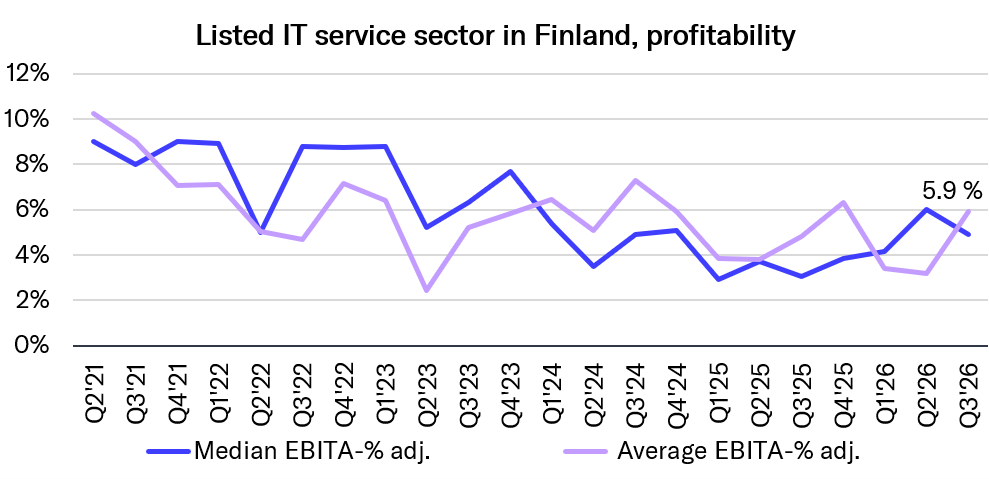
The sector's average adjusted EBIT margin was 5.9% in Q3, which was clearly higher than the comparison period (Q3’25: 4.8%) and Q2'26 (3.2%). The median profitability rose to 4.9% (Q3’25: 3.0%). The improvement from the comparison period in Q3 was primarily driven by efficiency measures implemented earlier in the year that took effect more successfully than expected across several companies. It is easier for companies to manage profitability if their revenue levels have stabilized because there is room for improvement in overall billing rates, and fixed cost structures can be scaled to some extent. For companies experiencing a widespread decline in revenue, managing profitability remains very challenging as efficiency measures inevitably "always" lag behind.
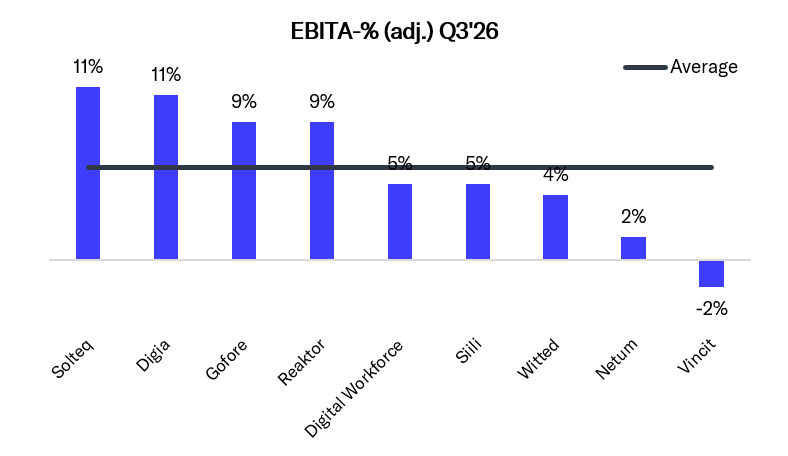
Depending on the company's profile, EBITA levels below 5% should, in our view, raise some questions about possible adjustment measures. Five companies (Digital Workforce, Siili, Witted, Netum, and Vincit) were below 5% in Q3, but the lower level in Digital Workforce's case is explained by growth investments, and Witted has achieved a significant profitability turnaround relative to its history and business model.
Among companies, Solteq (11.1%), Digia (10.6%), Gofore (8.9%), and Reaktor (8.9%) exceeded the historical sector average (7-8%). Solteq's profitability was a clear positive surprise, but shortly after the report, the company issued a profit warning regarding revenue, as customer order intake fell short of expectations. After the disappointment of Q2'26, Digia's profitability returned to a good level thanks to efficiency measures and improved billing rates, and Gofore's profitability was supported by synergy benefits, rising customer prices, and an improved billing rate. Siili’s profitability (4.9%) surpassed our expectations due to efficiency measures, while Netum’s (1.5%) clearly fell short of them. Witted's profitability (4.2%) also improved significantly and surpassed our expectations, despite a slight revenue decline, driven particularly by improved gross margins. Vincit’s adjusted EBITA, on the other hand, slipped into the red (-1.7%), and the benefits of the efficiency measures implemented early in the year were insufficient to turn the result around in the positive direction.
At the sector level, we expect profitability to improve further year-on-year as efficiency measures take full effect. On the other hand, several companies are still experiencing declining revenues with no quick turnaround in sight, which makes profitability management difficult. Thus, for a few companies (Netum, Siili, Solteq, and Vincit), the cycle of cost-cutting measures threatens to continue.
Source: Inderes
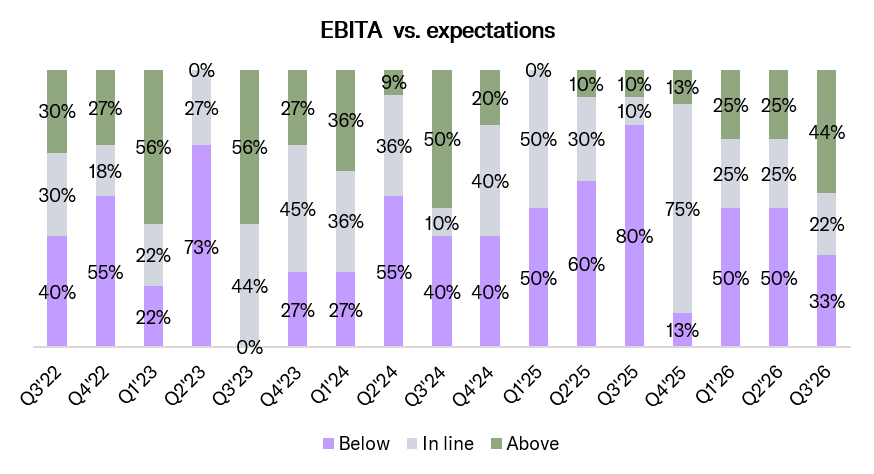
Relative to our forecasts, overall profitability levels were slightly ahead of our expectations, with 4 companies above, 2 in line (within 1 percentage point), and 3 below our forecasts. Together, the net effect of the differences in profitability expectations turned slightly positive, reaching +8.0 percentage points (Q2'26: -21 pp), driven by Solteq's clear beat. Our expectations were clearly missed by Netum and Vincit, as well as Digital Workforce, whose profitability was weighed down by growth investments.
If the revenue decline and difficult market situation persist, companies will be under additional pressure to also adjust their more fixed cost items. They have all adjusted their operations at least once in recent years, and change negotiations have become a normal way of adapting to changes in market conditions, so they are no longer seen as such dramatic events. In our view, this also creates an opportunity for more steadily developing companies to profile themselves as secure workplaces and strengthen their employer image.
Source: Inderes
2026 will again be a transition year in the context of the sector – we expect revenue to continue decreasing but profitability to improve
While some companies have a positive tone regarding their market outlook, multiple challenges and weak performances continue to drag revenue growth into negative territory at the sector level. In 2026, we expect organic revenue median development to be -1% (2025: -4%), and excluding the fast-growing Reaktor, the decline would be 3%. We expect median profitability to rise to 5.1% (2025: 3.5%), and even excluding Reaktor, our forecast (4.6%) is clearly higher than the comparison period. Our profitability forecast median rose from 3.5% in the Q2 review, driven particularly by upward revisions to Solteq's forecasts, while Netum's and Vincit's forecasts turned negative.
Similar to revenue, a clear dichotomy can be seen in profitability. For a few companies, good performance or improvement is driven by efficiency measures and improved billing rates, as several companies' revenues stabilize or show slight growth. For others, though, continuous revenue decline limits the benefits of efficiency measures, threatening to keep profitability weak. An additional challenge for the worst-performing companies with a strong software development background has been customers' cautious attitude toward AI-focused projects. In connection with the Q3 reports, we received further positive comments on the uptick in demand for these AI projects (incl. Siili and Digital Workforce), but in our view, demand still needs to pick up significantly before it begins to more strongly support these companies' performance.
We have for a long time already estimated that the current market situation and the market disruption created by artificial intelligence will more clearly separate the winners and losers in the sector. Now that the market disruption has continued for about three years, and companies have had time to adapt to the new situation, we can preliminarily begin to categorize market winners and losers. Based on recent years' operational figures, we believe that Digia, Digital Workforce, Gofore, Reaktor, and Witted have either continued to perform well relative to the sector and/or succeeded strategically in their transformation. From the perspective of operational figures and strategic effectiveness, the current losers in the sector are Siili, Solteq, and Vincit.
For Witted, the transition from organic growth to a slight decline in Q3 (-2.5%) and the low Rule of 20 figure (2) slightly diminish its track record, so we will closely monitor the company's positioning. Netum's categorization is still partly a question mark, as three major contracts have ended and are slowing down development. Along with its Q3 results, the company announced new targets for the 2027–2029 strategy period (approximately 10% annual organic growth and an EBITA margin of at least 10%), which, in our view, will require a stronger market environment than currently exists. Therefore, above all, the company needs a further acceleration in sales and evidence that the decline in revenue has stopped.
| 2026e (after Q3 report) | |||
| Growth, % | Organic growth, % | EBIT-% adj. | |
| Digia | 1% | -1% | 9.20% |
| Digital Workforce | 33% | 12% | 5.10% |
| Gofore | 21% | 2% | 8.40% |
| Netum | -18% | -18% | -0.80% |
| Reaktor | 13% | 13% | 13.00% |
| Siili | -10% | -10% | 2.10% |
| Solteq | -5% | -5% | 5.30% |
| Vincit | -14% | -14% | -0.40% |
| Witted | 4% | 0% | 4.00% |
| Average | 2.80% | -2.40% | 5.10% |
| Median | 1.00% | -1.40% | 5.10% |
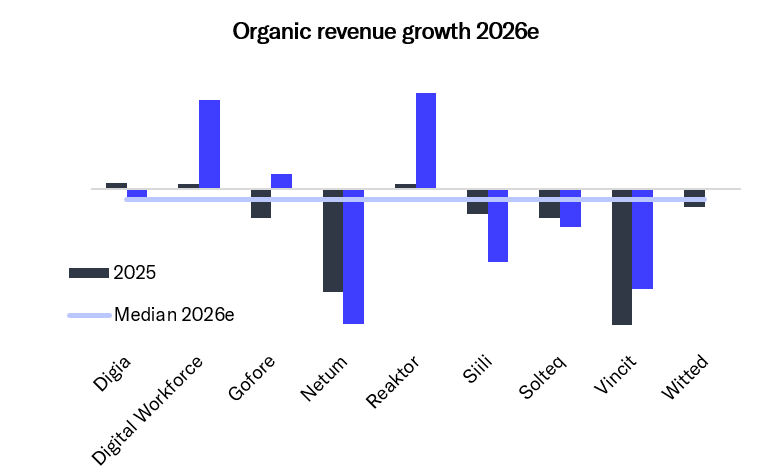
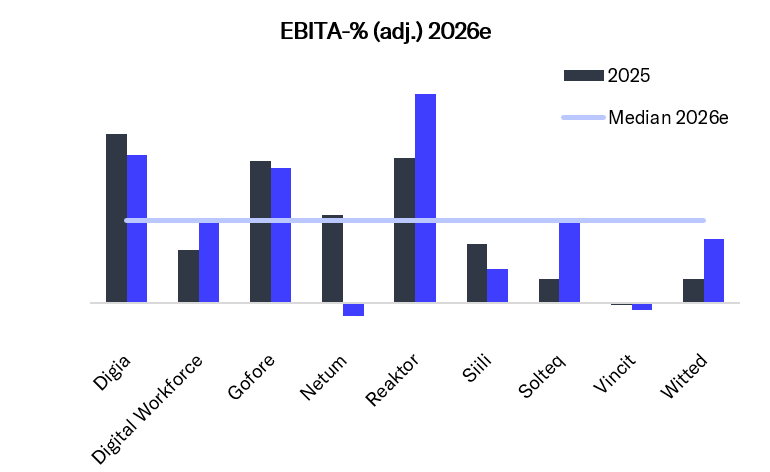
Source: Inderes
Company-specific Q3 comments and forecasts:
Gofore (in Finnish)
Netum (in Finnish)
Siili (in Finnish)
Solteq (in Finnish)
Vincit (in Finnish)
Witted (in Finnish)